The Resume Black Hole
Elena Rostova had submitted 242 applications in ninety days. The result? 238 automated rejections, three recruiter calls that went nowhere, and one coding challenge she completed but never heard back from.
Elena was self-taught. She had spent a year learning HTML, CSS, JavaScript, and React in the bedroom of her apartment.
"I was trapped in what I call the self-taught loop," Elena says. "You build a portfolio of projects, apply to junior roles, get rejected because you don't have a Computer Science degree or two years of experience, feel like an imposter, study more, and then repeat. It felt like trying to break into a bank with a plastic key."
Elena’s portfolio was filled with standard bootcamp projects: a calculator, a weather app, and a clone of Netflix.
"I realized that if I were a hiring manager looking at twenty junior resumes a day, and every single one had the same Netflix clone, I’d throw them all in the trash too," she says. "I needed a portfolio that proved I could solve real commercial problems, not just copy a tutorial."
The Local Business Experiment
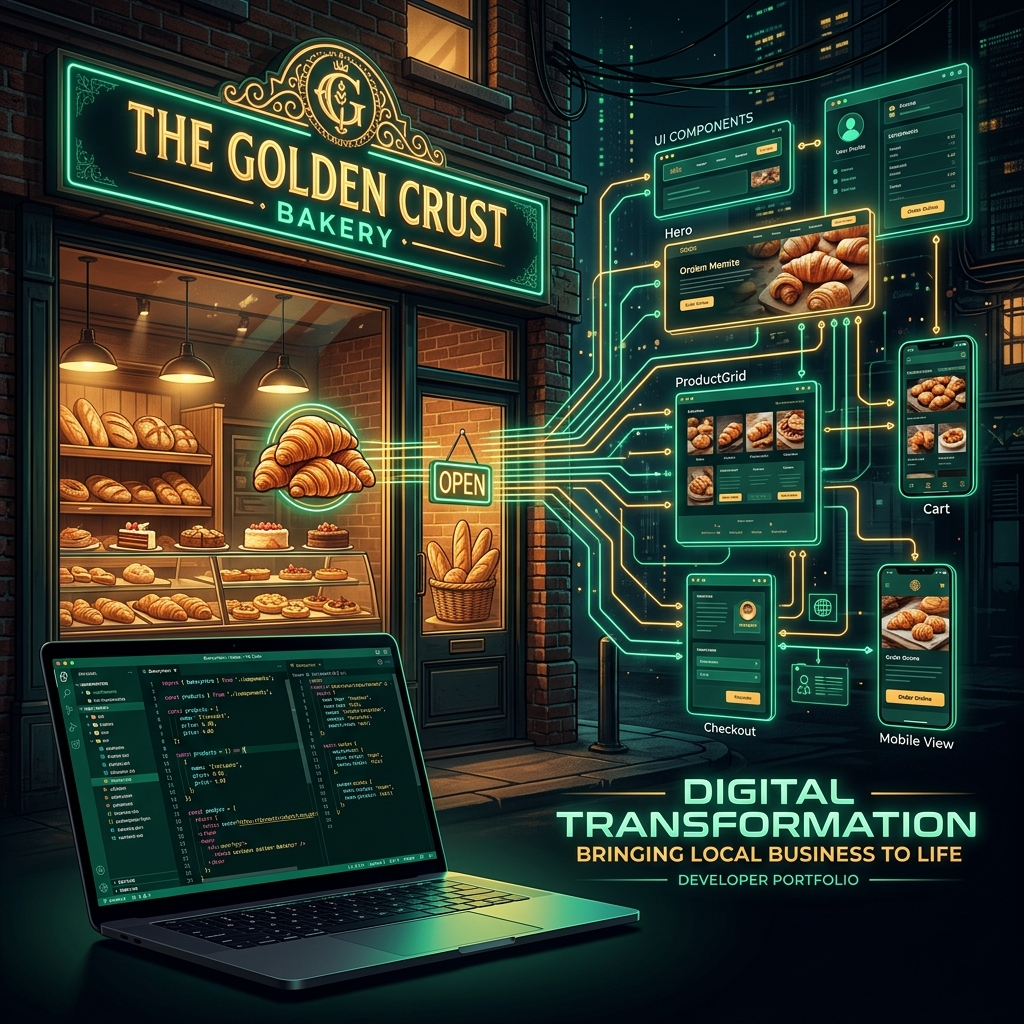
One afternoon, Elena was ordering bread from a local bakery down the street. Their website was slow, failed to load on her mobile phone, and the checkout form was broken.
She saw her opportunity.
She walked into the bakery the next day and asked to speak to the owner, a man named Tomas. "I told him: 'I’m a local developer building my portfolio. Your website is losing mobile customers. I will rebuild it for free using modern web technology. You only pay for the hosting.'"
Tomas was skeptical but agreed. Over the next three weeks, Elena didn't just write code; she acted as a full-stack consultant:
- She migrated their legacy site to Next.js.
- She optimized their image assets to decrease load time from 7.4 seconds to 1.1 seconds.
- She built a streamlined, responsive ordering form.
The Case Study That Changed Everything
When the site launched, she didn't just add a link to her portfolio. She wrote a detailed Technical Case Study.
She structured it like a professional engineering report:
- The Problem: The bakery's website load speed was causing a 40% bounce rate on mobile devices, impacting digital bread orders.
- The Solution: Built a lightweight static site using React, caching images on a global CDN, and designing an accessible checkout form.
- The Tech Stack: Next.js, Tailwind CSS, Vercel, and Formspree.
- The Result: Mobile load speeds improved by 85%, and digital order inquiries increased by 22% in the first month.
She replaced her "Netflix Clone" on her resume with \"Lead Frontend Engineer — Local Commerce Redesign (Case Study)\".
Breaking the Filter
Two weeks after updating her portfolio, Elena applied for a remote Frontend Engineer position.
The engineering manager didn't ask her about her lack of a college degree. Instead, during the interview, he pulled up her case study. "He told me it was the first time in months he had seen a junior developer explain why they chose a framework based on performance metrics rather than just 'following a tutorial,'" she says.
She got the job.
How to Build Your Own Commercial Portfolio
If you are a self-taught developer struggling to get noticed, stop building mock applications. Try this three-step blueprint:
- Find a Real Problem: Look at local small businesses, non-profits, or open-source libraries. Find a website that is slow, ugly, or functionally broken.
- Offer a Free Upgrade: Reach out to the owner. Offer to fix it for free in exchange for using it as a case study and getting a testimonial.
- Write the Performance Story: Don't just show the code. Explain the business problem, the technical trade-offs you made, and the performance outcome (speed, accessibility, user conversion).
In the tech industry, a working product that helps a business make money will always speak louder than a computer science degree.